

FeatureResearch
February 2026 Issue
Exploring Quantum Mysteries: When Hot Cools Faster Than Cold
Assistant Professor Shion Yamashika, Department of Engineering Science, University of Electro-Communications, Tokyo.
Shion Yamashika is advancing our understanding of quantum phenomena that challenge everyday intuition—from why “hot” quantum systems can cool faster than “cold” ones, to how black holes might radiate energy. His research connects deep theoretical questions with emerging quantum technologies.
From Wonder at the Universe to Quantum Physics
Yamashika’s fascination with physics began in childhood. “I often read an atlas of the planets,” he recalls. “When I saw that a solar prominence is higher than the Earth’s diameter, I was deeply moved by the scale and mystery of the universe.” That early sense of awe led him to explore the laws that govern nature on its smallest scales.
An undergraduate course on Bose–Einstein condensation—a state of matter where many particles share the same quantum state—cemented his passion for quantum physics. “The idea that a macroscopic number of particles can behave as one quantum entity convinced me I wanted to study quantum mechanics,” he says.
Decoding the Quantum Mpemba Effect
One of Yamashika’s most notable recent studies explores the quantum Mpemba effect, the quantum counterpart of the classical paradox where hot water can freeze faster than cold water. In collaboration with global theorists, he analyzed this effect in long-range interacting quantum spin systems, where many tiny magnets influence each other across distances.
“In our study, we found that stronger initial disturbances—larger tilts in the spin orientation—can actually relax faster because they amplify quantum fluctuations,” he explains. “These fluctuations spread through the system, erasing the disturbance more quickly.”
His theoretical work helped clarify the microscopic origin of experimental observations reported in 2024, offering a bridge between abstract theory and laboratory reality.
Surprising Contrasts in Quantum Models
In his 2025 paper in Physical Review A, Yamashika investigated how theoretical frameworks themselves shape predictions. By comparing two common approaches—the Gaussian variational method and the standard Bogoliubov theory—he found that one predicts the quantum Mpemba effect while the other strictly forbids it.
“I expected only small quantitative differences,” he notes, “but the contrast between possibility and impossibility was qualitative—and the fact that the simpler model allowed a clean mathematical proof was striking.”
Simulating Black Holes in the Lab
Yamashika also explores quantum simulations of Hawking radiation, the mysterious emission predicted to occur at black hole horizons. “The bridge between quantum mechanics and gravity is one of the deepest open problems in physics,” he says. “What excites me most is that we can now create laboratory analogues of black holes using ultracold atoms, trapped ions, or photonic systems to test these ideas experimentally.”
Collaboration and Future Vision
Although primarily a theorist, Yamashika follows the rapid progress of quantum experiments closely. “I try to frame questions that can be tested on platforms like ion traps or Bose–Einstein condensates,” he says. He also emphasizes collaboration with other theorists, noting that “working with colleagues who have complementary strengths often leads to clearer mechanisms and more elegant results.”
Looking ahead, Yamashika envisions applying his research on nonequilibrium quantum phenomena to practical quantum technologies. “My long-term goal is to translate theoretical insights into methods that help operate quantum devices more efficiently,” he explains. “Fundamental understanding can ultimately guide the design and control of next-generation quantum systems.”
References
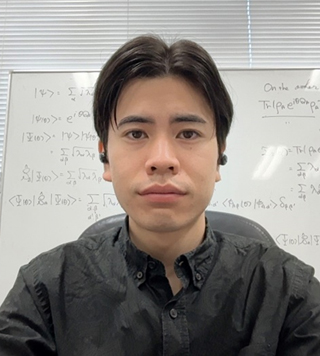
Assistant Professor Shion Yamashika
Shion Yamashika’s research focuses on quantum dynamics, entanglement, and nonequilibrium phenomena in many-body systems, with recent studies published in Physical Review related journals.
- WEBSITE : https://researchmap.jp/ShionYamashika
1. S. Yamashika, P. Calabrese, F. Ares, Quenching from superfluid to free bosons in two dimensions: Entanglement, symmetries, and the quantum Mpemba effect, Physical Review A 111, 043304 (2025).
DOI: https://doi.org/10.1103/PhysRevA.111.043304
2. S. Yamashika, F. Ares, P. Calabrese, Entanglement asymmetry and quantum Mpemba effect in two-dimensional free-fermion systems, Physical Review B 110, 085126.
DOI: https://doi.org/10.1103/PhysRevB.110.085126